Most HMO landlords have had a fire risk assessment carried out. Fewer have asked what that assessment is actually measuring against. The answer, in most purpose-built HMOs, is nothing documented — and that gap has real consequences for compliance, liability, and the safety of the people living in the building.
What a Fire Strategy Is
Design teams produce a fire strategy at the design stage of a building. It sets out the fire safety philosophy, how the building protects occupants in the event of a fire, which passive and active measures are in place, how people are expected to evacuate, and the standard to which the building meets.
It is the specification against which everything else is measured.
For a purpose-built HMO, a fire strategy should have been produced as part of the Building Regulations approval process. It will have informed decisions about compartmentation, detection, alarm systems, means of escape, and structural fire resistance. Those decisions shaped the building that exists today.
A fire strategy is not a fire risk assessment. The two serve fundamentally different purposes.
The Relationship Between a Fire Strategy and a Fire Risk Assessment
A fire risk assessment, required under the Regulatory Reform (Fire Safety) Order 2005, is an assessment of the fire risk in a building as it currently exists. It identifies hazards, evaluates the risk to occupants, and records actions required to reduce that risk to an acceptable level.
To do that properly, the fire risk assessor needs to know what the building was designed to achieve. The fire strategy provides that benchmark. It is the manufacturer’s specification. The FRA is the MOT.
An FRA conducted without a retained fire strategy is assessing risk against an unknown intended standard. The assessor may identify defects, but without the original design rationale, they cannot determine whether those defects represent a departure from the intended standard or whether the building’s current condition is consistent with its design intent.
For the Responsible Person, this matters. The Fire Safety Order requires a “suitable and sufficient” fire risk assessment. An assessment conducted without reference to the building’s fire safety design basis is, by definition, incomplete. The Responsible Person cannot fully demonstrate compliance.
Why Purpose-Built HMOs Have This Problem
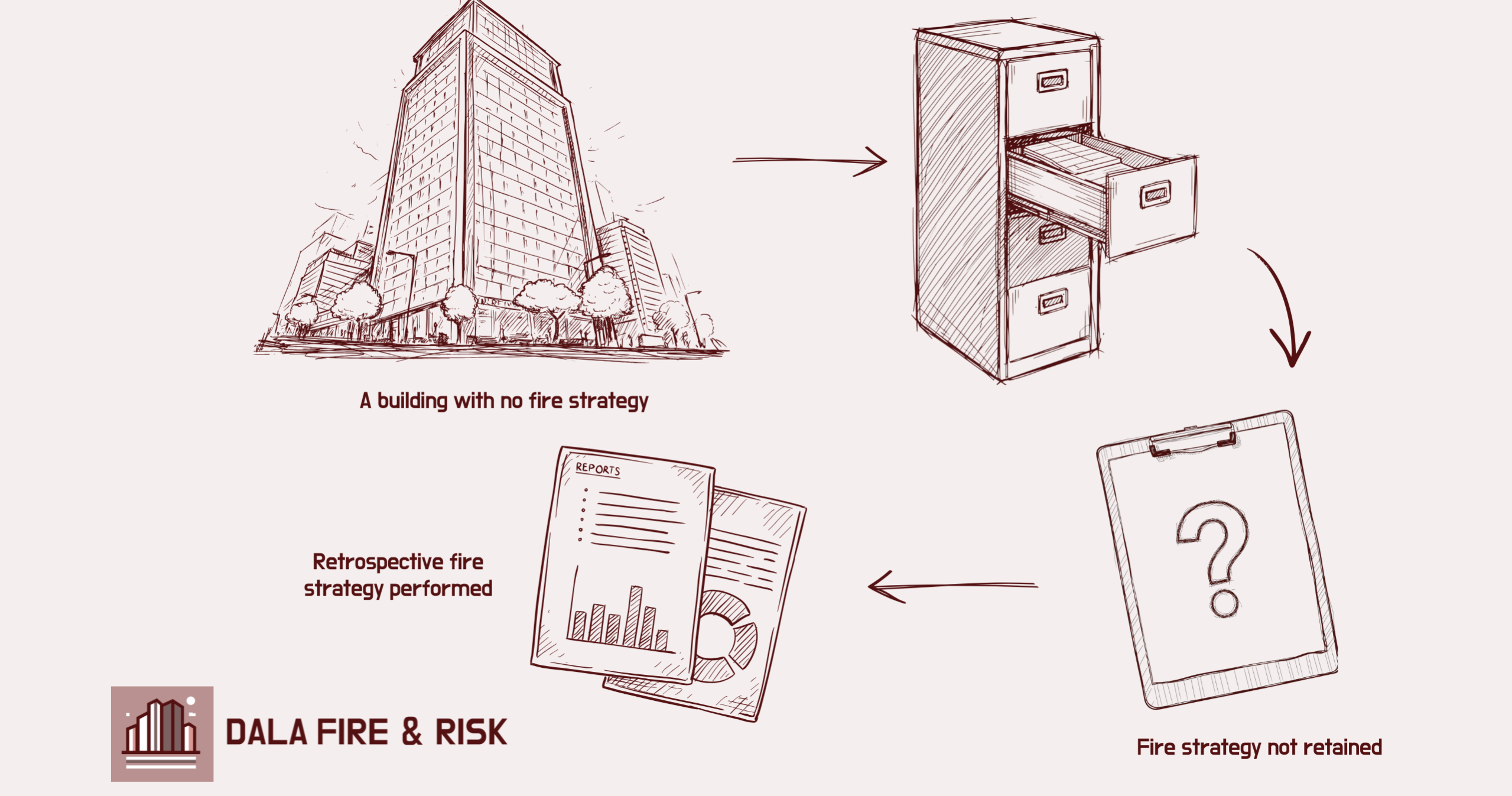
Purpose-built HMOs — blocks converted or constructed specifically for multi-occupancy residential use — should have had fire strategies produced at design stage. In practice, most do not retain them.
The reasons are straightforward. Buildings change hands. Managing agents change. Documents get lost in transitions between owners, solicitors, and local authorities. Original design teams move on. Fire strategies produced for planning or Building Regulations purposes are not always carried forward into the operational management of the building.
The result is a significant proportion of the HMO stock operating without documented evidence of what they were built to achieve — and Responsible Persons conducting fire risk assessments against no documented design standard.
This is not a niche problem. It is the default position for the majority of purpose-built HMOs in England and Wales.
The Legal Position
There is no provision in legislation that explicitly names a fire strategy as a mandatory document for an HMO by that term. But the absence of an explicit requirement does not mean the absence of an obligation.
The Fire Safety Order requires the Responsible Person to carry out a “suitable and sufficient” assessment of the risks to relevant persons. For that assessment to be suitable and sufficient in a purpose-built HMO, the assessor must be able to assess the building’s current condition against an intended standard. Without a fire strategy, that standard is undocumented.
HMOs are also subject to a dual regulatory framework — fire safety duties under the Fire Safety Order sit alongside licensing obligations under the Housing Act 2004. Local authorities cannot issue an HMO licence unless satisfied that appropriate fire precaution equipment and facilities are in place. Without a fire strategy, demonstrating that the building’s fire precautions are adequate — rather than simply present — becomes significantly harder.
For HMOs that fall within scope of the Building Safety Act 2022 — those 18 metres or above, or seven storeys or more, with at least two residential units — the obligation becomes more explicit. The Safety Case regime requires the Accountable Person to demonstrate that all building safety risks are being managed. A documented fire engineering basis for the building’s fire protection measures is effectively essential to that demonstration.
Beyond statute, HMO licensing authorities increasingly scrutinise fire safety arrangements as part of licensing applications and renewals. Fire and Rescue Services attending incidents expect to find evidence of a managed, documented fire safety regime. The absence of a fire strategy is an exposure — legally, operationally, and in the event of an insurance claim.
What a Retrospective Fire Strategy Involves
A retrospective fire strategy is produced for a building that is already in use, in the absence of retained design-stage documentation.
It involves a qualified fire engineer assessing the building as-built. Examining the actual construction, compartmentation, means of escape, detection and alarm provision, suppression systems where present, and structural fire resistance, and producing a document that records the fire safety design basis of the building as it exists.
This is not a theoretical exercise. It requires physical investigation of the building, professional judgement about the fire engineering principles at work, and a clear written record of the intended standard, so that future fire risk assessments and alterations can be measured against it.
The retrospective fire strategy then becomes the benchmark. Future FRAs assess the building against it. Future alterations (additional bedrooms, reconfigured layouts, changes to compartmentation) are designed with reference to it. The Responsible Person has a documented position.
Who Needs One
If you are the Responsible Person for a purpose-built HMO and you cannot produce the original design-stage fire strategy, the answer is almost certainly: you.
That is not a criticism of how you’ve managed the building. It reflects the reality of how the sector retains, or fails to retain, fire safety documentation. The gap is industry-wide.
What matters now is closing it. An FRA conducted against a documented fire strategy is a defensible position. An FRA conducted without one is an assumption.
Get a Qualified Assessment
DALA Fire & Risk produces retrospective fire strategies for purpose-built HMOs and multi-occupied residential buildings across England and Wales. Our qualified fire engineers carry out every assessment and produce a clear, defensible document that gives your fire risk assessment a benchmark to work against.
Call us on 02381 551000 or email enquiries@thedala.group.
References and Further Reading
- Regulatory Reform (Fire Safety) Order 2005 — primary fire safety legislation and the Responsible Person’s duty to carry out a suitable and sufficient fire risk assessment
- Housing Act 2004 — HMO mandatory licensing regime and fire safety licensing conditions
- Building Safety Act 2022 — GOV.UK guidance — higher-risk buildings regime, Safety Case requirements, and Accountable Person duties
- Higher-Risk Building criteria — GOV.UK — definition of buildings in scope of the BSA higher-risk regime
- Approved Document B — Fire Safety — Building Regulations guidance on fire safety, within which fire strategies demonstrate compliance
- Guide for persons with duties under fire safety legislation — GOV.UK plain-English guide to Responsible Person duties
- Fire Safety (England) Regulations 2022 — additional duties for Responsible Persons in multi-occupied residential buildings above 11 metres